Yazgi Demirbas Pech: Bio-inspired Architecture For Mars (MARS SUIT-HABITAT project, 2023)
Yazgi Demirbas Pech is a Paris-based Turkish architect whose work explores architecture in extreme environments, from outer space to deserts and oceans. Confronted with the realities of climate change, she places sustainability and the careful management of resources at the core of her practice.
Her creative influences include Japanese culture, parametric design, biomimicry, and science fiction. She also works as an illustrator, exploring diverse themes and mediums to expand her visual and conceptual research.
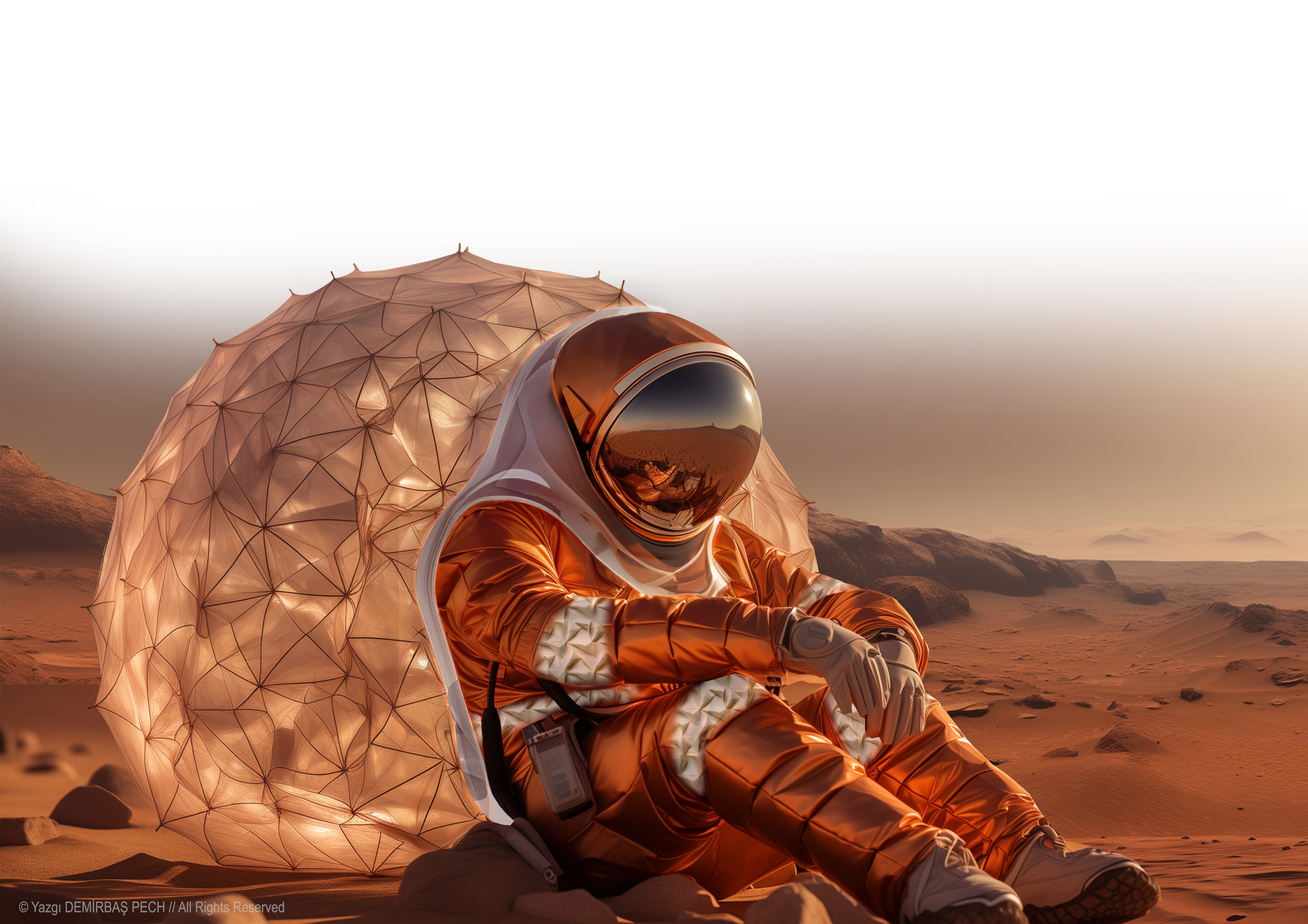
Her conceptual project ‘Mars Suit-Habitat’ suggests the design of a spacesuit that could transform into a temporary habitat in case of emergency.
To feel at home is not merely to occupy space, but to establish a continuity between body and environment. Home, in this sense, is not defined by enclosure or permanence, but by proximity, protection, and responsiveness. In extreme environments, architecture must cease to function as a fixed container; it must instead operate as an extension of the body—responsive, protective, and inseparable from human presence. Beyond Earth, this shift becomes unavoidable.
As human exploration extends toward the Moon and Mars, established architectural typologies begin to dissolve. The spacesuit—among the smallest yet most complex spacecraft—emerges as a critical spatial interface. More than a technical apparatus, it functions as a mobile micro-architecture, mediating between the human body and a hostile environment. Mars, as the next decisive frontier of exploration, frames the Mars Suit–Habitat project: a spacesuit conceived to transform into a compact emergency habitat
The Mars-Suit Habitat
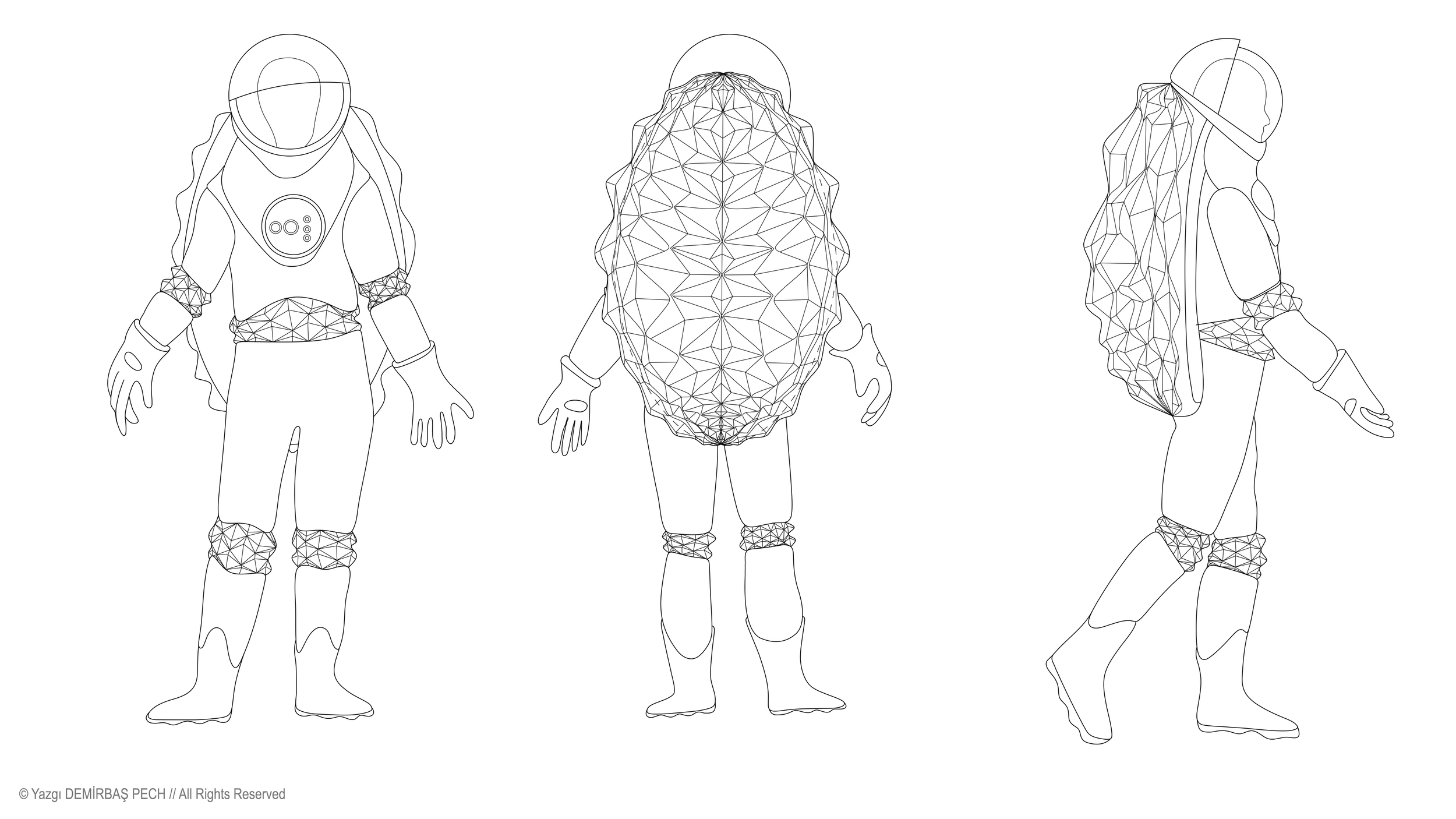
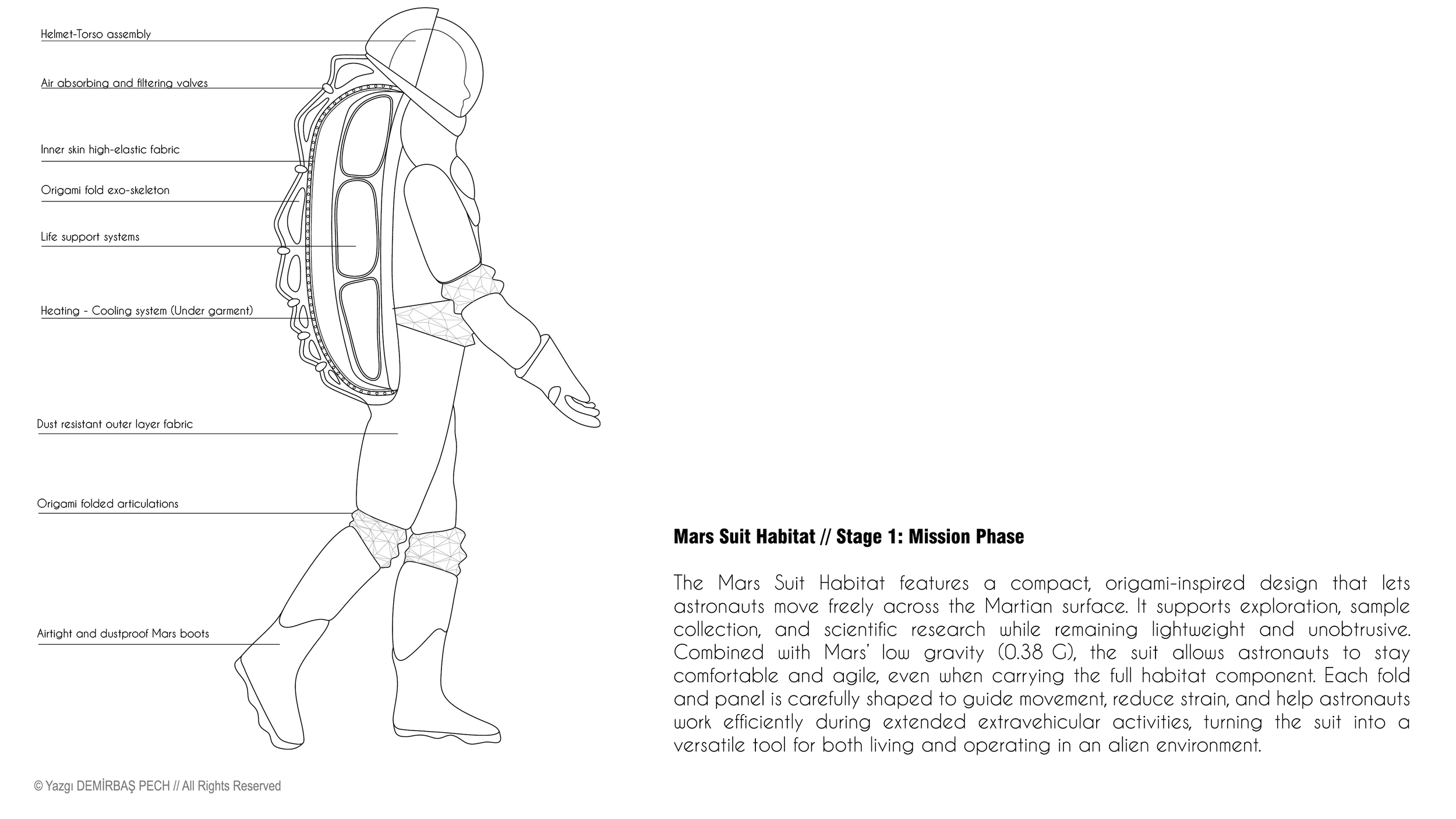
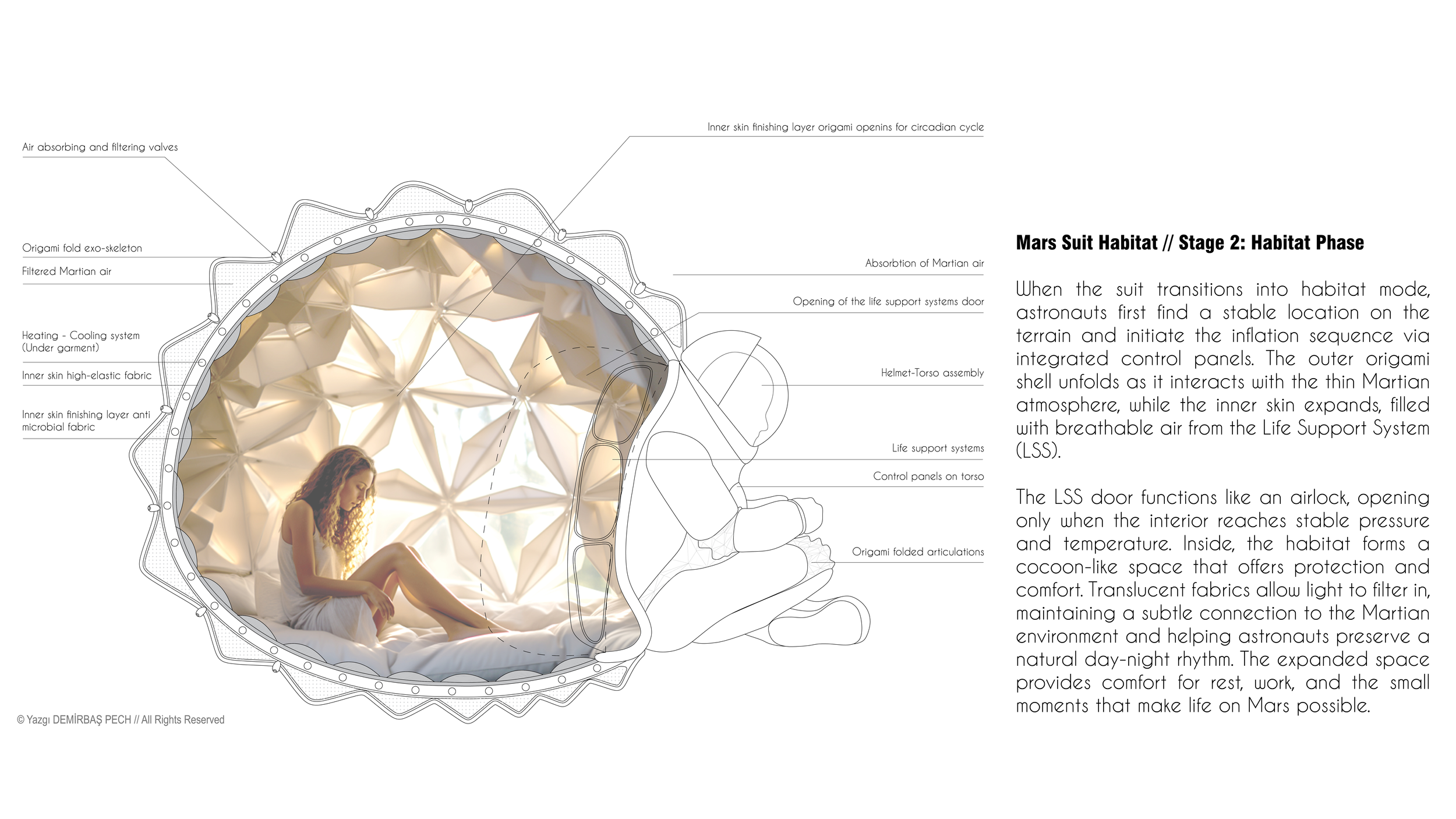
Mars presents an unforgiving environment, demanding adaptability, efficiency, and resilience. The Mars Suit–Habitat responds with a dual-purpose system. It functions first as a lightweight, sustainable Mars suit, and second as an emergency shelter for astronauts operating far from a primary base. By merging suit and habitat into a single architectural entity, the project explores a first-generation living system for early human missions, balancing spatial efficiency with material economy.
Biomimicry: a tool to design for space
Biomimicry is employed as a central design strategy, guiding both the architectural logic and material behavior of the suit. Biomimicry is a design approach that looks to natural systems, structures, and processes as sources of insight for solving complex challenges. Shaped by millions of years of adaptation, biological strategies often balance efficiency, resilience, and minimal use of resources—qualities that are especially relevant in extreme environments.
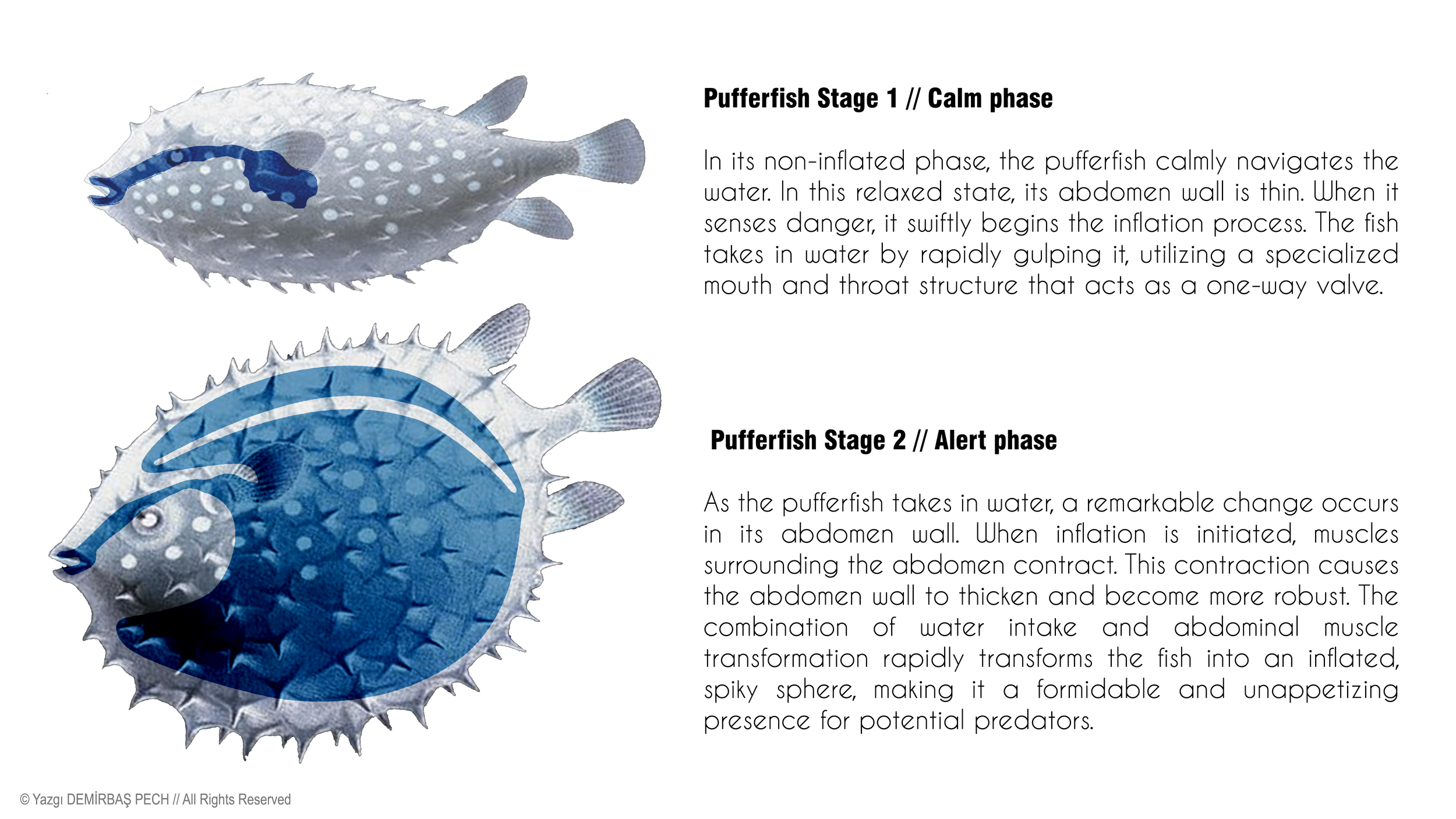
Puffer fish biomimicry © Yazgi DEMIRBAS PECH, all right reserved
In the context of space exploration, where constraints of mass, energy, and adaptability are critical, biomimicry offers a way to rethink habitats, materials, and systems.
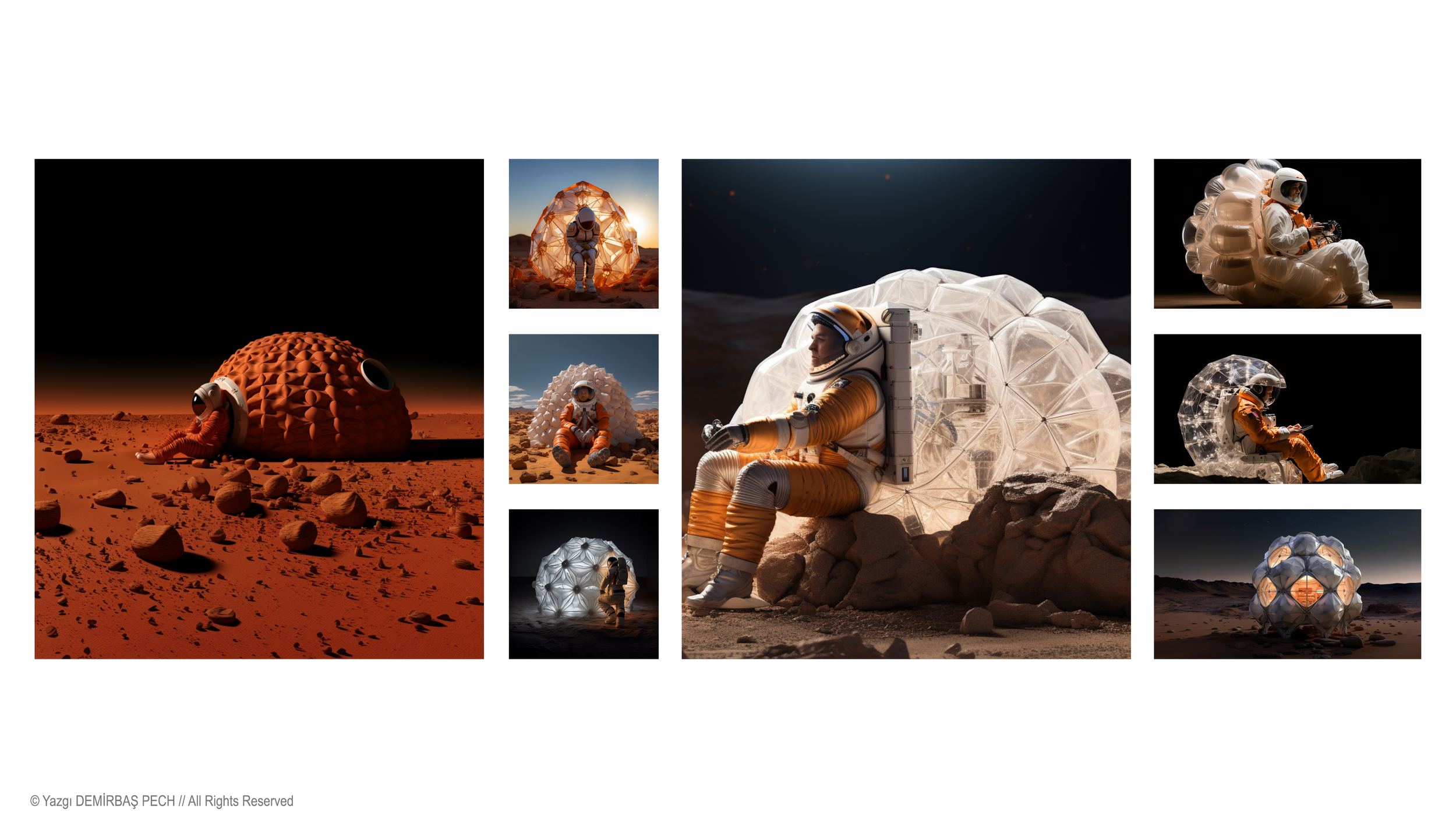
Inspired by the pufferfish, the system of the project uses an origami-based transformation mechanism that allows it to expand when required. The outer skin—an origami “mattress” structure—interacts with the Martian atmosphere, filtering and absorbing it as part of the transformation process. Beneath this layer, an inner cocoon functions like a stomach, expanding to create a controlled interior environment. Life support systems integrated within this inner skin ensure breathable air and thermal stability, maintaining astronaut safety and comfort.
Once deployed, the Mars Suit–Habitat shifts from protective equipment to inhabitable space. It offers a temporary interior for rest, recovery, and pause, reframing survival infrastructure as a momentary dwelling. In doing so, the project questions the limits of architectural scale and permanence in extraterrestrial contexts.
This project was developed as a conceptual design proposal for an international design competition, where it received an Honorable Mention.vWhile the project currently exists at a conceptual level, further technical development may be pursued by the designer in the future
MARS SUIT-HABITAT, Yazgi DEMIRBAS PECH (2023)