Ayesha Mubarak Ali: A suit is never just a suit
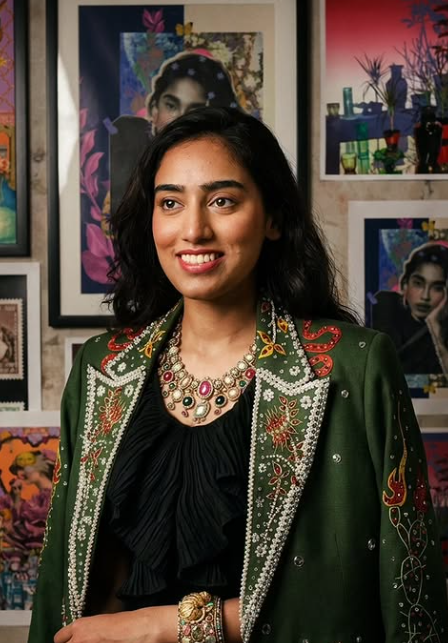
Ayesha Mubarak Ali is an internationally acclaimed Pakistani artist and creative director, Forbes 30 Under 30 Asia honoree, and the first Pakistani artist to collaborate with NASA scientists.
Her practice operates at the intersection of frontier space research, identity politics, and sustainable futures. It is informed by the lenses of collective memory, ethical technology, and emotional mapping.
I trained as a visual artist at the Indus Valley School of Art and Architecture, where I learned that every material carries memory. Thread remembers the hand that pulled it. Pigment remembers the earth it was ground from. A surface is never neutral; it is an accumulation of decisions, some deliberate and some inherited, all of them legible to those who know how to read. When I later began working with fashion, with couture, with wearable form, I carried this understanding with me: that what we put on our bodies is never merely functional. It is a declaration. It is a negotiation between who we are told to be and who we insist on becoming.
The space suit fascinated me for precisely this reason. It is the most extreme garment ever conceived, a sealed architecture of survival, engineered to sustain a human body in an environment that would destroy it within seconds.
And yet, when I studied its cultural presence, its iconography, its place in our collective imagination, I kept encountering the same absence. The suit had been designed as though the body inside it carried no gender, no cultural inheritance, no interior life. It was designed for a function. Not for a person. And function, I have learned, is never as innocent as it pretends to be. Function encodes assumptions. Function decides what matters and what can be discarded. When a suit is calibrated for one kind of body and presented as complete, every other body becomes an afterthought, a problem to be solved rather than a perspective to be included.
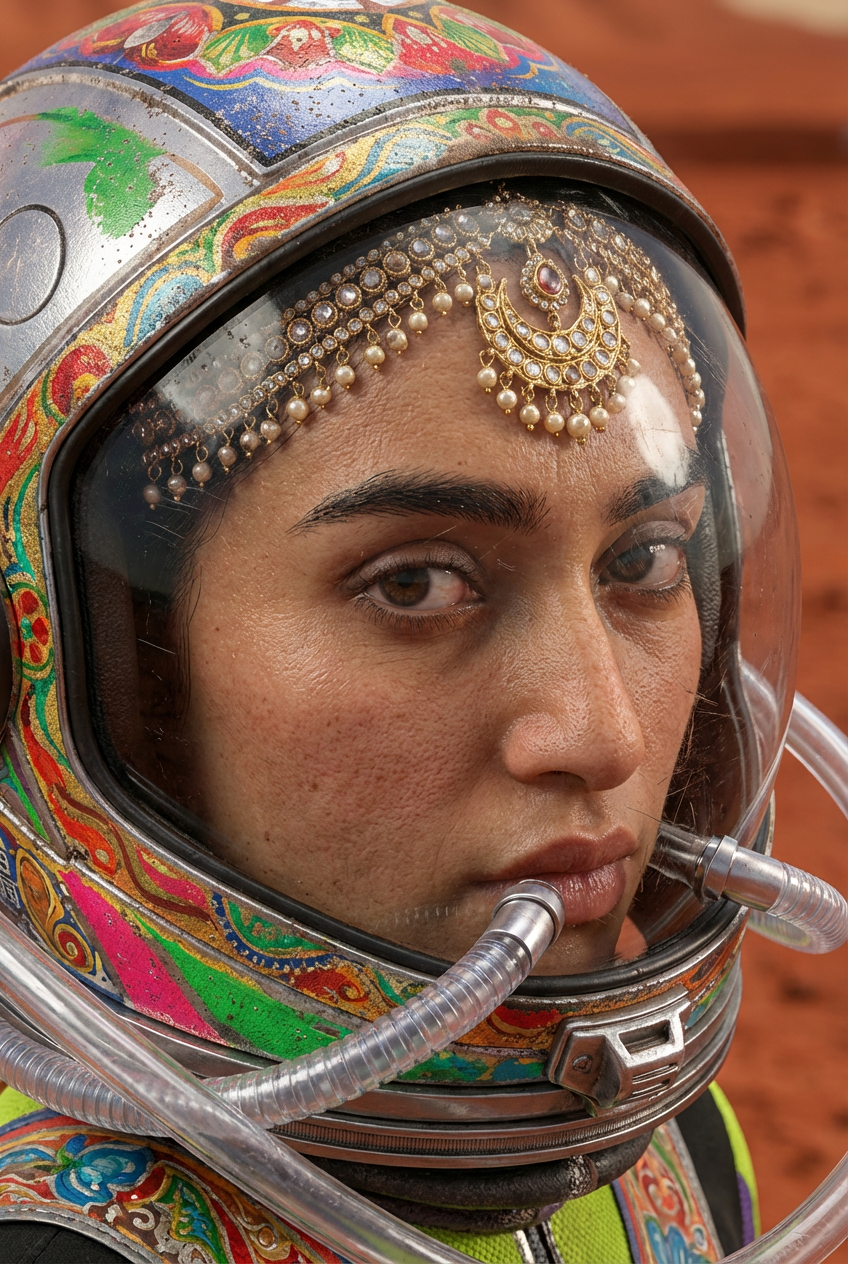
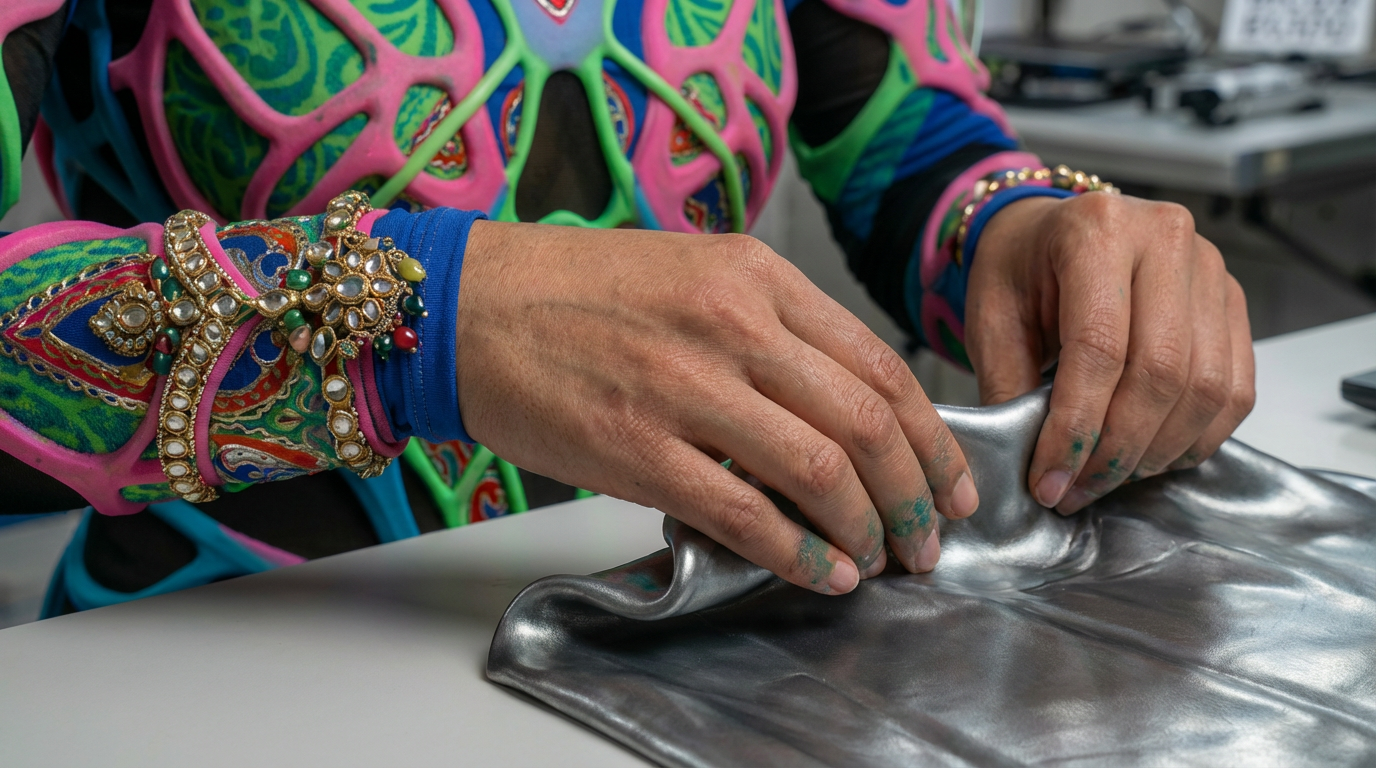
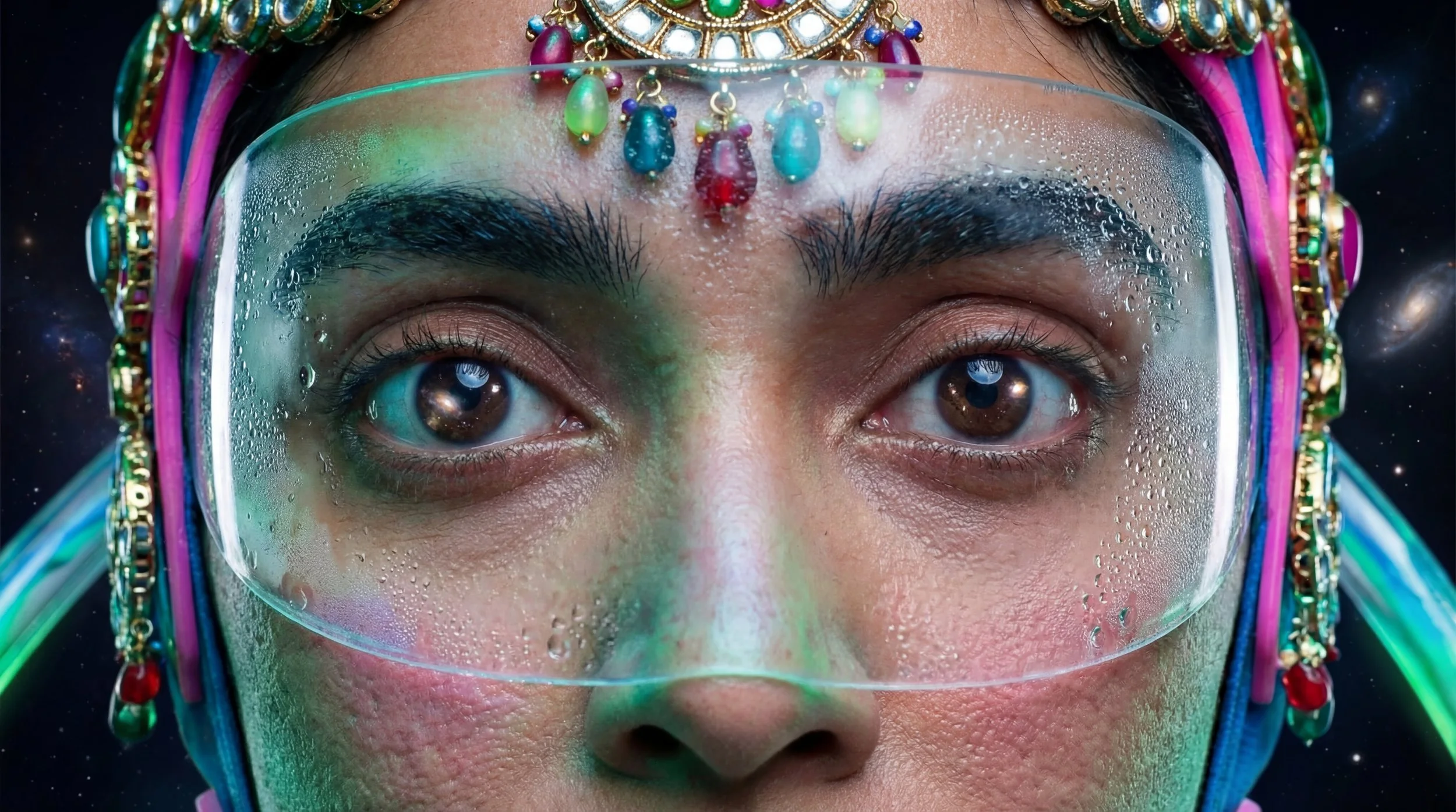
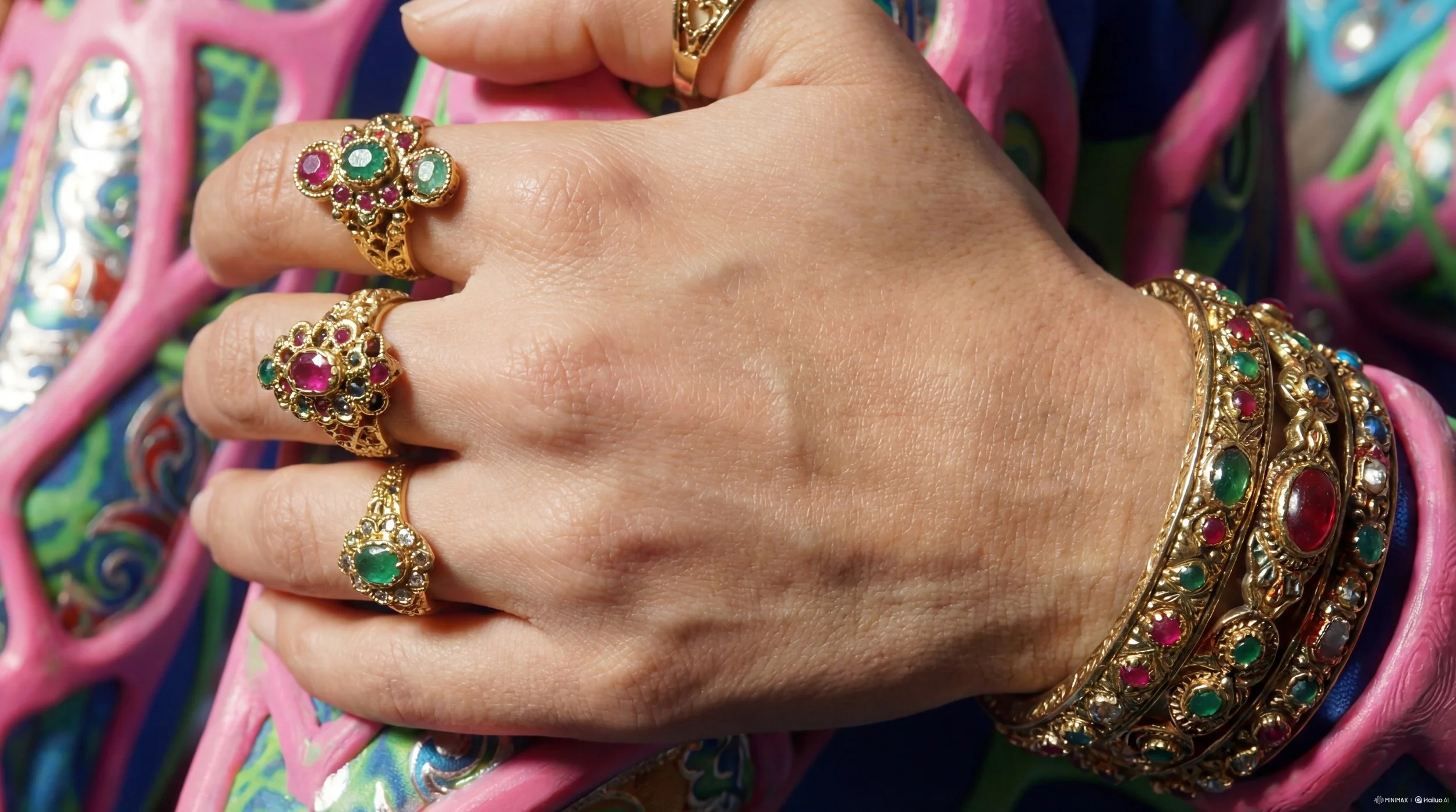
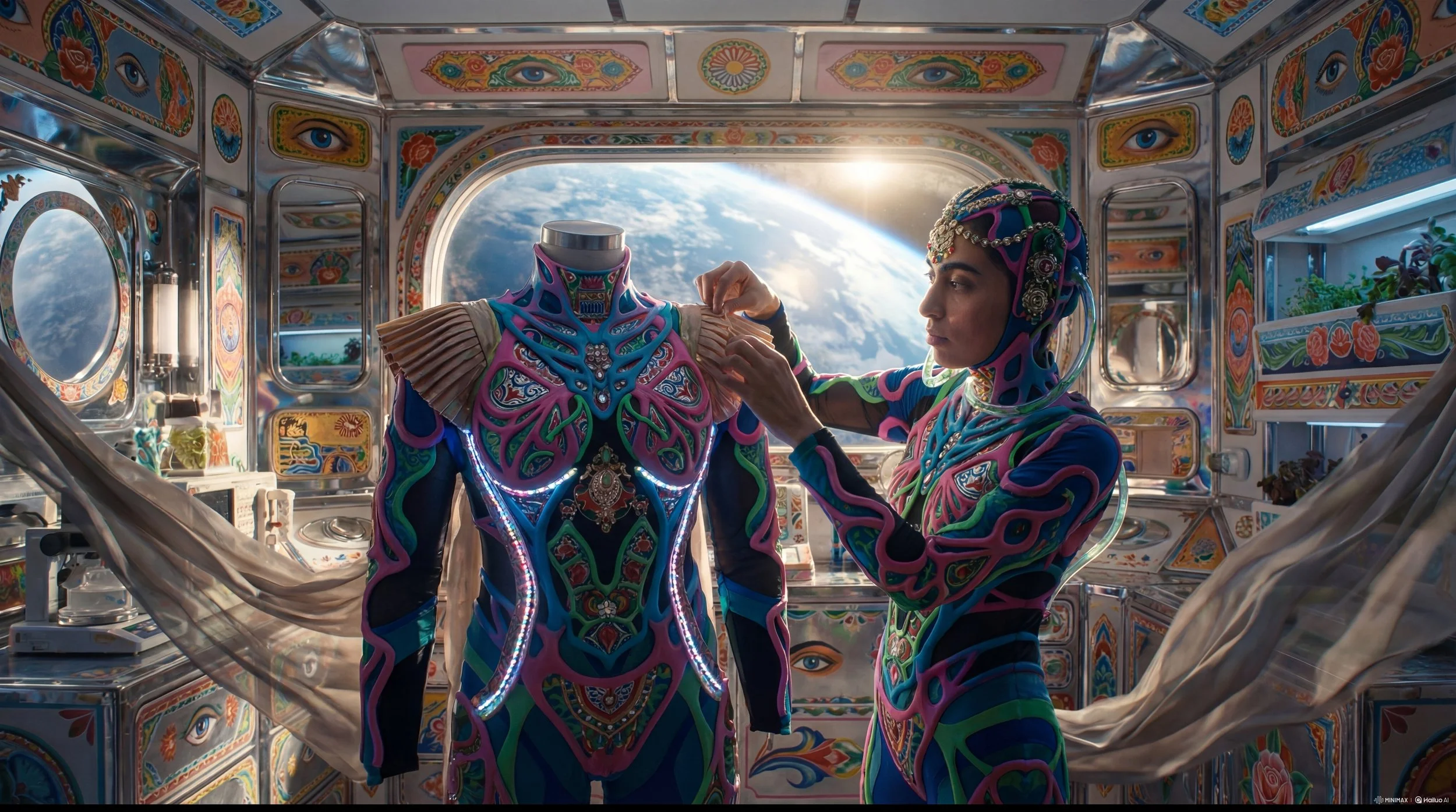
The orbital habitat in the short film, in which the suit appears, is not a sterile white module. It carries trace patterns, geometric recurrences, color harmonics, structural ornaments—that do not announce their origin but do not conceal it either. They are present the way an accent is present in a second language: not as failure to assimilate, but as proof that the speaker carries another world inside her. The spaceship, like the truck, is a machine designed elsewhere for a purpose defined by others. And like the truck, it has been claimed. Not through protest. Through craft. Through the stubborn insistence that the space you inhabit should know something about the person inhabiting it.
I did not want this to be legible as nostalgia or cultural branding. I wanted it to provoke a harder question: why do we accept that a vessel moving through the most hostile environment conceivable should be stripped of all cultural specificity? Why is blankness the default aesthetic of the future? Whose comfort does that blankness serve? The truck painters of Rawalpindi and Peshawar understood something that the architects of orbital modules have not yet grasped—that a human being sealed inside a moving structure, cut off from the familiar, surrounded by danger, does not need minimalism.
And so the suit the astronaut wears carries those same frequencies. Not replicated, not sampled, not quoted. Translated. The deep magentas and cobalts that blaze across the Karakoram Highway at dusk, compressed into a visor tint. The geometric confidence of jingle-truck panel work, distilled into seam architecture. The pinks and golds that, on a Bedford truck, announce presence against a vast and indifferent landscape—here, in orbit, performing the same function against a vastness that is darker and more indifferent still. The suit does not explain itself. It does not need to. It carries, in its color and construction, the same ancient insistence: I am here, I came from somewhere, and I refuse to disappear into the blankness you have prepared for me.
I am often asked why space. Why, as a Pakistani woman artist working across painting, fashion, film, and speculative media, do I keep returning to the cosmos? The honest answer is that space is the most unforgiving mirror I have found. On Earth, the structures that shape our lives—social hierarchies, gendered expectations, cultural scripts—are so deeply woven into the landscape that they become invisible. We breathe them. We mistake them for nature.
But in space, there is no inherited atmosphere. Every system of support must be designed, fabricated, and maintained deliberately. Nothing is assumed. And in that radical exposure, the questions that terrestrial life allows us to defer become unavoidable. Who designs the air you breathe? Whose assumptions hold up the walls that protect you? What happens when the intelligence meant to assist you begins to anticipate your thoughts and you cannot tell whether this is care or surveillance?
When my artwork traveled to the International Space Station aboard SpaceX in 2022 for Project Maleth II, something shifted in my understanding. The work I had made—rooted in emotion mapping, collective memory, the textures of identity—was orbiting the Earth at twenty-eight thousand kilometers per hour. It existed in a context that had no knowledge of Karachi, no memory of coastal light on Clifton beach, no framework for the specific inheritance I carry. And yet it was there and it persisted.
This experience made concrete something I had been circling for years: that cultural memory does not dissolve when you remove it from its geography. It translates and finds new form. The question is whether those new forms are recognized as meaningful, or whether they are treated as noise within systems that define clarity very narrowly.
Not Your Average Astronaut lives inside this question. The astronaut carries her lineage into orbit not as cargo but as methodology in the way she solves problems, in the aesthetic instincts that guide her fabrication choices, in the patterns she introduces into structures that would otherwise forget her. Heritage is not decoration. It is design intelligence. And the future, I insist, is not culturally vacant. It is negotiated. It is marked. It carries forward everything we bring to it, whether or not the systems around us are built to notice.
The making of the suit began not with software, but with the body—its limits, its memory, its quiet negotiations with space. I drew it first by hand, returning to the discipline of sketching as a way of thinking through touch rather than speed. Each line carried a question: how does a surface protect without erasing softness, how does a structure hold without silencing movement?
From these drawings, the suit evolved into form, traditional compression fabrics layered with plissé expansions that could breathe with the body, held together by an internal metallic armature designed for both protection and endurance. Over this, a 3D-printed chest piece emerged, not as armor alone but as a second skin, its embossed surfaces carrying the visual language of truck art, translated from flat ornament into something that could curve, hold, and exist in motion.
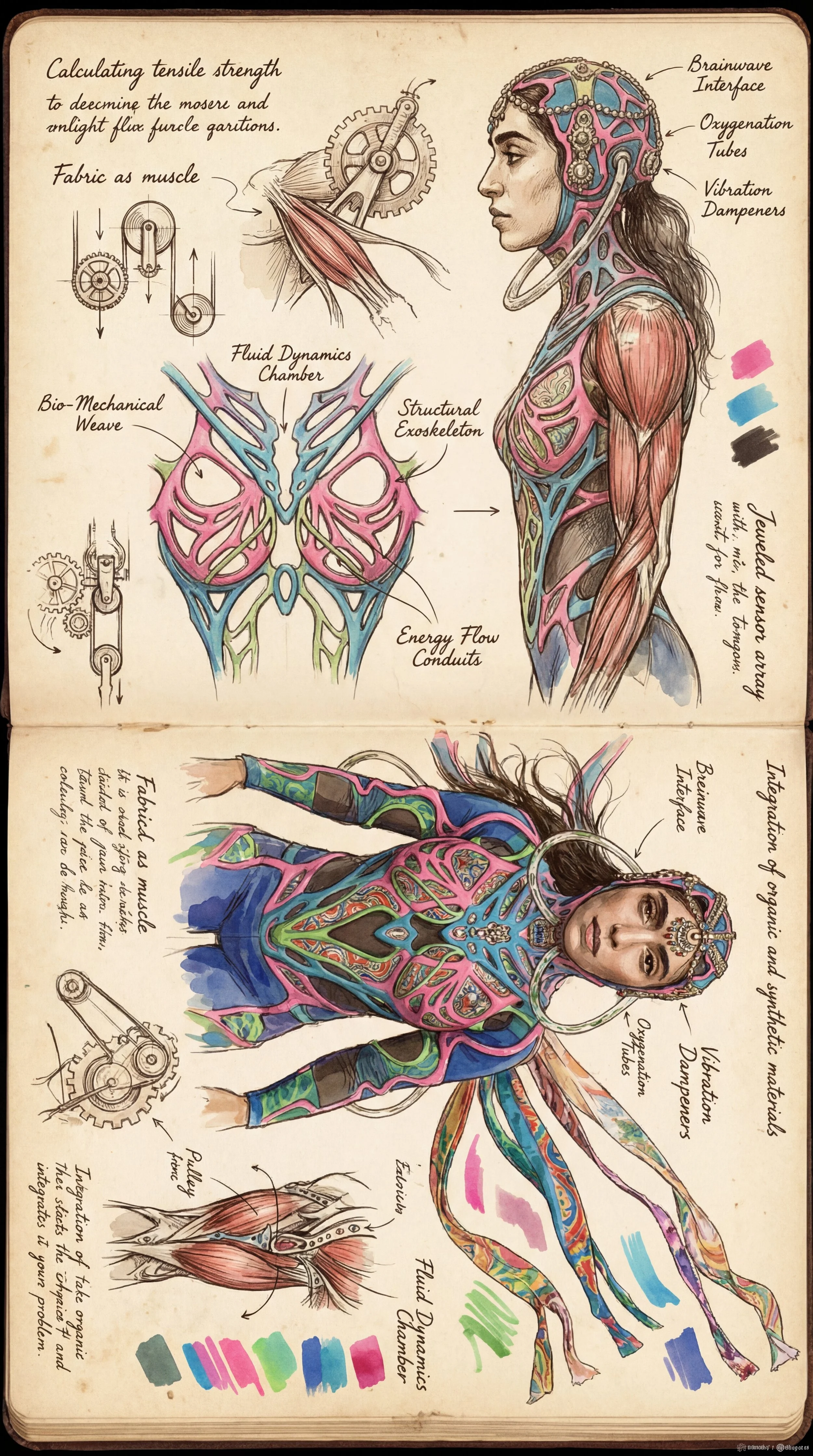
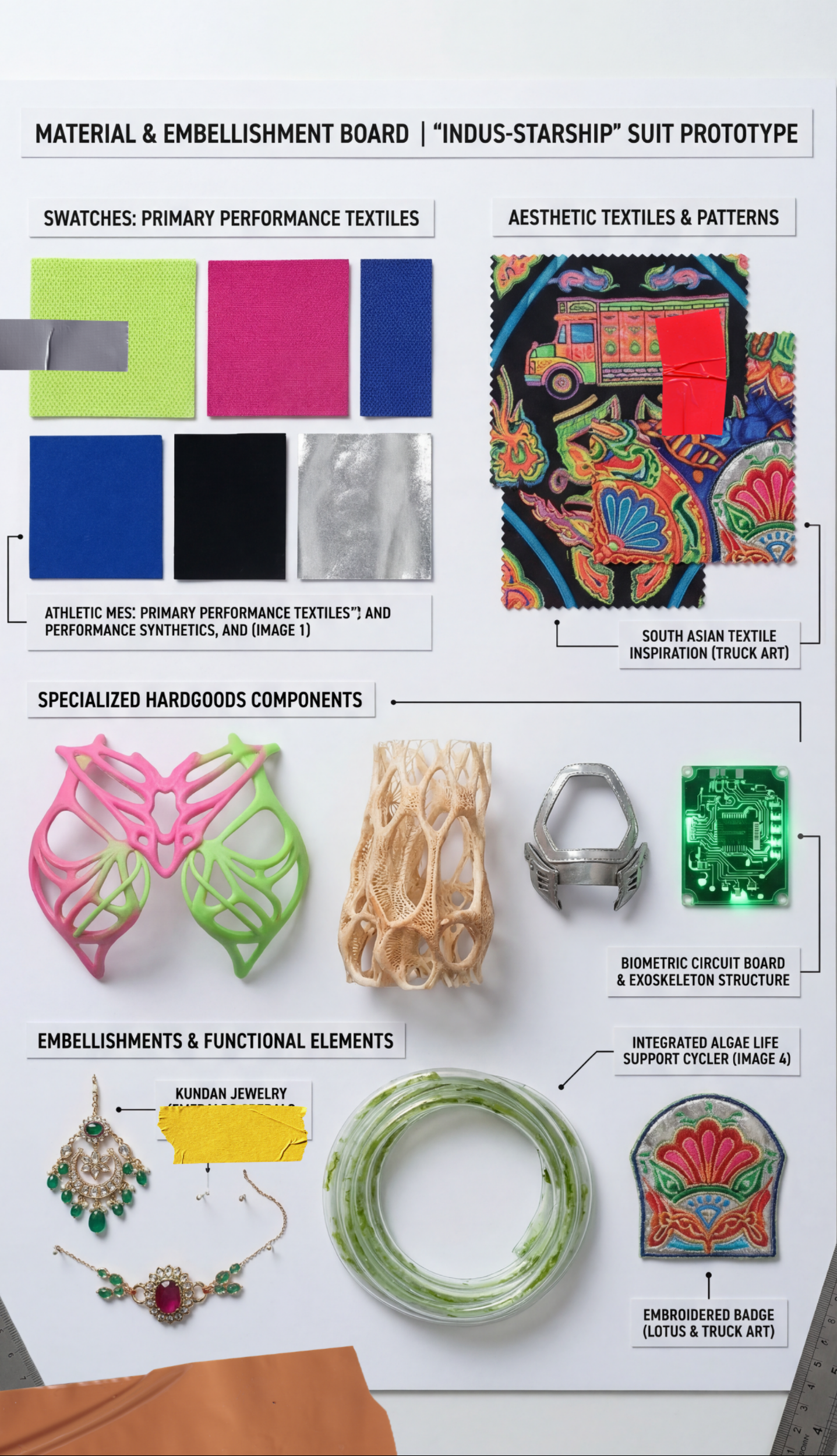
The integration of kundan and silver beadwork was never ornamental in the superficial sense. These elements were embedded into the suit as points of contact between body and machine, past and future doubling as sensor nodes that quietly recorded pulse, temperature, and movement. Tubes carrying bioluminescent algae traced the suit like veins, offering a living light that responded rather than imposed, while oxygen pockets and filtration systems were distributed with care, allowing the suit to sustain brief moments of solitude in space—those in-between states of travel, of waiting, of working within compression. The color palette followed a similar logic of balance: pink holding a sense of intimacy and presence, blue grounding the structure, and neon green interrupting both as a signal of energy, of alertness, of something still becoming.
What mattered to me was not resolving these contrasts but holding them in tension. The suit exists between fiction and function, between inherited aesthetics and speculative futures. The same South Asian visual language, drawn from truck art, from architectural detail, from the rhythm of ornament—was extended beyond the body into the imagined interiors of the station itself, so that the wearer is never separate from her environment. The process followed its own ethics: the hand came first, always. Sketches became models, models became systems, and only then did I allow machine learning tools to enter—trained on collected fragments of traditional patterns and materials. These tools did not design the suit; they helped me see it differently, to place it within a space that could move, breathe, and respond.
In the end, the suit is less an object than a philosophical proposition. A way of asking how much of where we come from can travel with us into the uninherited dark and what it means to carry that into a place that was never designed to hold it, that has no language yet for what we bring.
Ayesha Mubarak Ali, 2026
Notes on the use of AI for this artwork
The film could not have been made through any single method, because the questions it asks do not belong to any single discipline. Not Your Average Astronaut was produced through a hybrid methodology that mirrors, in its very process, the entanglement of human and machine intelligence that the film interrogates. The spacesuits were designed manually, sketched, revised, debated with myself the way a tailor debates with fabric, through intuition and error and the slow accumulation of decisions that no machine can replicate because they are rooted in doubt rather than optimization.
The cultural motifs,the geometric grammars of truck art, the ornamental logics inherited from Mughal miniature borders, from mosque tile work, from the painted panels of Rawalpindi workshops, were mapped in three dimensions, translated from flat surfaces into spatial forms that could wrap around a helmet, contour along a suit seam, inhabit the interior walls of a habitat module. This translation was itself a creative act: not copying pattern onto new material but asking what a motif designed for a Bedford truck fender becomes when it must exist in zero gravity, when it must curve around a body that is floating rather than standing, when it must mean something to a woman who may or may not be human.
Once these elements were built, manually designed, dimensionally mapped, culturally grounded, AI-driven masking and generation tools were used to compose the scenes, to produce movement, to give the frames their breath and drift. I was deliberate about the sequence. The hand came first. Cultural intelligence came first. The machine entered only after the human decisions had been made, only after the motifs carried their weight, only after the suit knew whose body it was remembering.
I did not want AI to author the film. I wanted it to serve the film the way wind serves a sail—providing motion, but not direction. The direction had already been set by hand, by heritage, by the slow and unglamorous work of sitting with a sketch until it tells you what it needs. This method was not efficient. It was not meant to be. It was meant to be honest about where meaning originates and where it does not, about what machines can move and what only a human hand, carrying the memory of other hands before it, can place.