Substrate (Studio created by Nick Houde and Lukáš Likavčan): Culture on both sides of the Kármán line
Substrate is a ‘boutique intelligence studio’ aiming to help organizations understand and shape the future of technology, ecology, and space.
Working across research, strategy, and storytelling, Substrate develops original frameworks and narratives for start-ups, academic institutions, brands, space agencies, and NGOs navigating the ethical, ecological, and geopolitical challenges of emerging technologies and space exploration. Their approach focuses on uncovering counterintuitive insights and overlooked problem spaces, helping partners build more grounded, forward-looking projects.
It was created by Lukáš Likavčan and Nick Houde:
Lukáš Likavčan is a philosopher whose work rethinks ecology in relation to technology and outer space. With a background spanning institutions such as NYU Shanghai, the Berggruen Institute, and the Strelka Institute, he has collaborated widely across academia and cultural organizations, contributing to discussions on environmental humanities, planetary systems, and the future of space exploration.
Nick Houde is a researcher and strategist with over a decade of experience working across the technology industry, academia, and cultural institutions. His work bridges brand strategy, emerging technologies, and ecological thinking, helping organizations better understand how technological and environmental shifts are reshaping society.
Philosophy has spent the last few millennia trying to understand what it means to be human. One of the most unique approaches to this enigmatic concept emerged from the work of Jamaican philosopher Sylvia Wynter, who described being human as a practice constructed through the long history of cultural techniques and technologies that have enabled humans to have agency over the stories that guide the evolutionary trajectory of our species.
For Wynter, the emergence of the human species is synonymous with the invention of cultural systems that underwrite the collective human flourishing in tandem with living environments and other species. How we narrate these systems, therefore, has a major impact on where our species will go in the future, orienting human sense of purpose and a shared planetary destiny.
While Wynter herself never explicitly discussed outer space, both of us found a point of orientation in her work as we tell stories about our increasing human habitation off-Earth, which (probably not ironically) coincides with a moment when the terrestrial conditions of our home planet are so strained that they obviously challenge many aspects of human culture we have held dear in the past: governance and social institutions that help coordinate our cooperation, and enable the spirit of curiosity both inside and outside science. The story of our species on both sides of the Kármán line is changing.
Substrate was born out of questions about human purpose, both individually and collectively. After all, we both come from philosophical backgrounds that intrinsically concern these kinds of questions.
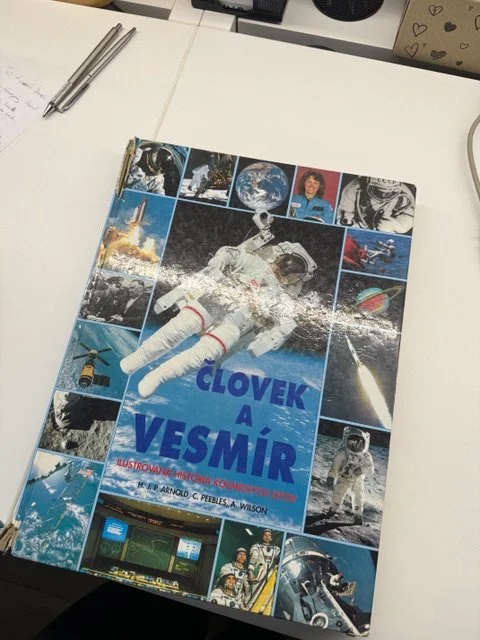
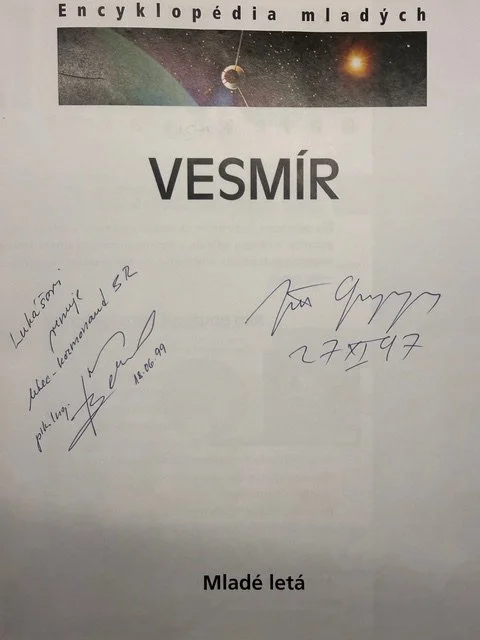
Lukáš grew up in the Slovak countryside, where both dreaming about outer space and reading philosophy tracts provided an anchor for intellectual aspirations and a safe space from everyday realities. When he was six, the Sojourner rover landed on Mars, and he still remembers the thrill of making a pilgrimage to the lecture of Czech astronomy popularizer Jiří Grygar to celebrate that occasion and getting him to sign a thick book on the history of space exploration.
Later, while working on his environmental philosophy PhD, he realized that most of his work concerns a planet called Earth, and perhaps it makes sense to probe what a planet is from an astronomical perspective to better understand how to care for this one planet we inhabit. Not neatly fitting into disciplinary boxes, he has always craved to increase the consequentiality of his work by studying design, working at think tanks, and running cultural institutions.
Nick spent his teenage years watching the open sky of the Western Colorado desert through the filter of Carl Sagan DVDs and early sci-fi blogs, which gave him a utopian space to project his imagination and political ideas. Later on, while working for a German cultural institution for many years, he projected those same projections to convey the importance of the Earth sciences to the public as we careened into an age of planetary-scale technology — the Anthropocene.
These ideas would naturally lead him to thinking about ecology and technological development off-Earth and the political imaginaries soon to develop. Like Lukáš, he wondered how this speculative work could become more consequential and began collaborating with organizations, brands, and technologists on the ways culture and curiosity inflected their processes.
The idea for the studio emerged from conversations at a workshop in Amsterdam, where art and technology practitioners were convened to think about how best to leave the domain of exhibitions behind so we could play a larger role in the creative R&D happening around the world with advanced technology. We have seen the hunger in the room for building cultural infrastructures that openly interface and shape cultural narratives of technology adoption, seeking a sense of purpose beyond merely scaling compute or launching thousands of satellites to speed up the circulation of symbols, vibes, values, credit, and ornaments in human communication.
Meanwhile, we noticed the space industry undergoing an extraordinary expansion. Most of the conversation, however, is still framed in engineering terms: propulsion, life-support thresholds, orbital mechanics, payloads. Of course, these matters carry enormous weight, but as these engineering projects evolve into sending more and more humans beyond the Kármán line, we will need to explore the keystones of human cultural production like governance structures, diverse practices for enabling scientific curiosity, and stories that help us coordinate action beyond Earth. For us, that’s what we mean by exploring culture on both sides of the Kármán line: not art or the “normal” cultural artifacts, but the entirety of cultural practices like governance, wellbeing, taste, meaning, and communication structures that allow humans to cooperate and thrive.
That is why we started Substrate. We work with startups, space agencies, and cultural institutions to develop the narratives, strategies, and cultural frameworks to foster a more generous sense of what it means to build human systems for habitation, wellbeing, and governance in the next era of space activity. We believe that scientific curiosity can be reborn through new explorations of the cosmos, serving as a foil for learning about ourselves as planetary inhabitants, always in the midst of practicing what it means to be human.
Nick Houde and Lukáš Likavčan, 2026